I toured a little on a conventional bike some years ago, and this involved panniers. The experience was acceptable but for the usual discomfort of diamond frame bikes. I did not really become a cycle tourist until I started riding recumbents. I've toured on several different types of "bents" so far:
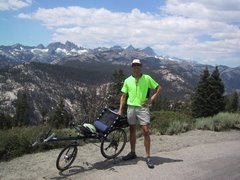
Tour Easy:

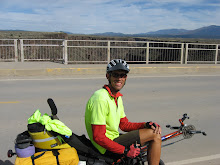
Haluzak Horizon:

Greenspeed Tandem Trike:

As you can see, the Greenspeed has a little of everything. We added the trailer for our faithful hound, Django, who trots alongside when the hills go up. This is a slow rig for a host of reasons, but it's a fine touring platform nonetheless.
My principle experience towing a trailer on a single bike comes from a tour I did across California and Arizona. As pictured above, I pulled a Burley Nomad behind my Haluzak Horizon. The trailer performed flawlessly and offered a few nice advantages: First, it packed easily, and once you popped the cover, everything was easy to find, just like a suitcase; second, when I parked to go shopping, and I was nervous about leaving it unattended, I could easily unhook the unit and drag it with me into the store whilst I procured my kippers and beer; third, it seemed to encourage a bit wider berth on the part of passing motorists. The wider, strange stance might have had something to do with it. And, least of all, it is kind of cute.
So why am I a currently confirmed pannier man? Weight, drag, and complexity. The trailer has all three. There's no doubt. It is a load of hardware to drag around. It's a bit bulky; the wheels provide some resistance on the pavement, and the tires can go flat--though I've experienced only one flat on the Burley and that on a training run. Although the handling of the bike isn't really affected, there is a bit of noise and hassle moving it around at times. Think of driving a car with a trailer and scale back to bicycle size. Turnarounds in tight places can be a chore as well as fitting between tight objects, such as trees, barriers to paths, etc. Ultimately, however, I kept coming back to the weight issue. The trailer, without extra tubes, checks in at about 14 lbs. Now, regular racks and panniers do weigh something and offset the difference somewhat, but I've found the ultimate solution.
The recumbent bicycle offers some serious benefits for touring. In terms of load carrying, one can fit bags under the seat and between the wheels, lowering the center of gravity and leaving the handling of the bike virtually unchanged. See the Tour Easy photo above. That beast, fully loaded for that winter tour in the desert, probably weighed about 80 or 90 lbs, especially with food and water (slosh, slosh). It handled perfectly. Now that I ride short wheel base recumbents (subject of another post to follow), I've found the final solution: Radical Designs bags made in Holland. Although my Street Machine can handle an under seat rack, these bags make it unnecessary. The load is still carried fairly low and forward and in a very aerodynamic shape, fitting virtually in the shadow of my legs and torso. Don't underestimate the value of a slippery design. Wind is a drag, especially a stout headwind that saps the legs and spirit on a long day in the saddle. The power of the recumbent position and these bags was driven home to me on a tour down the California coast last summer. I was leading a couple of Euro's through the wilds south of Santa Cruz when we topped a short climb. I, just a little ahead, eased over the top and simply left them in the dust, vanishing specks in my rear view mirror. I did not pedal. All this talk of aerodynamics my sound silly to the uninitiated: Dude, like, you're on a bike, dude, going really slow. Certainly, we travel more slowly than cars, motorcycles and fighter jets, but cyclists battle the elements in a more meaningful way. Every ounce of drag from a headwind is an ounce of power that must be supplied by the intrepid adventurer's legs. Chrysler and BMW do not provide the power plant. Mile after mile, hour after hour, little improvements can add up to a big difference. Another very nice feature of the Radical bags is that they require no hooks or tightening straps. One just drapes the bags over seat and rear rack and presto, tour ready are we. And the weight? I save fully TEN POUNDS.
I had the interesting pleasure of riding my Haluzak Horizon in both configurations: With trailer as featured above and with a medium-sized set of Radical panniers. This is what nailed the choice for me. It's just a tight package that was a pleasure to ride. Note that currently only the medium size can be purchased with connecting straps sufficient to handle seats as wide as that on the Haluzak. The large size, however, can easily be adapted with some extra buckles and strapping material.
Here's the 'Zak with panniers. These mediums were a little small, so I lashed my tent and pad to the sides of the seat:
 Tight rig, Mister!
Each rider will chose for himself what suits his personal style of riding and tastes. Just call me a Radical Pannier Man.